
Whether you’re running a construction fleet, a quarry, or a recycling operation, the wear steel you specify isn’t just a material decision. It’s a maintenance decision, a downtime decision, and a bottom-line decision.
At General Machine, we talk to a lot of fleet managers and plant operators who are frustrated — not because their equipment isn’t doing the job, but because they’re replacing wear parts more often than they should be. Liner swaps on excavator buckets. Hammer wear on shredders. Chute liners in recycling hoppers that need attention every few months.
When we dig in, the culprit is usually the same: commodity AR plate.
It’s not that AR plate is bad steel. It’s that it’s often the wrong steel — and the difference between “wrong” and “right” compounds fast when your equipment works as hard as yours does.
AR400, AR450, AR500: What the Numbers Actually Mean
Abrasion-resistant plate is rated by Brinell hardness. AR400 sits around 400 HBW. AR500 at 500 HBW. The logic seems straightforward: harder plate lasts longer.
Here’s what the spec sheet doesn’t tell you.
Standard AR plate is hardened through the entire cross-section but isn’t manufactured to tight tolerances on microstructure, toughness, or through-thickness consistency. That means two plates from two suppliers, both stamped AR450, can perform very differently in the field. You’re buying a hardness number, not a guaranteed service life.
Hardox®, SSAB’s wear plate line, is manufactured to tighter tolerances across hardness, impact toughness, and flatness. Hardox® 450 is nominally comparable to AR450 on paper. In practice, fabricators and fleet operators consistently see longer service intervals, better weldability, and more predictable behavior under impact. That last one matters a lot in construction and recycling applications where the loading isn’t uniform, it’s dynamic, abusive, and relentless.
The Construction Fleet Case: Why Your Excavator Buckets Are Your Tell
If you’re managing a construction or quarry fleet, excavator buckets are your canary in the coal mine for wear steel performance.
A bucket sees abrasion from the material, impact from digging, and stress concentration at the cutting edge and sidewalls. When the liner material underperforms, you’re not just replacing a wear plate, you’re scheduling downtime, pulling a machine from the line, and eating the labor cost to swap it out.
Operators who’ve moved from commodity AR plate to Hardox® 450 on their bucket liners typically report:
- Longer intervals between liner replacements often 30–50% depending on material type and operating conditions
- More consistent wear patterns, which makes inspection and life prediction easier
- Better formability and weldability during fabrication, which means tighter fitment and fewer field failures at weld seams
That last point is underappreciated. A liner that’s hard to weld cleanly is a liner that’s going to fail at the attachment point before the base material wears out. Hardox® is designed to be fabricated, not just endured.
The total cost of ownership math on wear steel almost always favors the better material — even when the upfront price per plate is higher. Fewer change-outs, less downtime, lower labor cost per unit of service life.
The Waste & Recycling Case: Downtime Is the Real Enemy
Recycling and waste processing operations run differently than construction fleets, but the wear problem is just as acute, and arguably less forgiving.
A construction site can absorb an unplanned equipment day. A recycling facility running at throughput targets on a contract schedule often can’t. When a shredder goes down for liner replacement, or a hopper chute fails mid-shift, you’re not just dealing with a maintenance cost. You’re dealing with a throughput hit, a potential contractual issue, and a crew standing around waiting.
The materials in waste processing are also more complex than a straight abrasion scenario. You’ve got shredder hammers hitting dense, irregular material with significant impact energy. Chute liners seeing both sliding abrasion and corrosive chemistry from organic material and moisture. Hopper liners that need to handle both impact and the kind of low-angle sliding wear that eats softer steels fast.
This is where grade selection becomes genuinely important:
- Shredder hammers and liners: High-impact applications benefit from Hardox® 500 or 500 Tuf, which adds toughness without sacrificing hardness. Straight AR500 can crack under repeated high-impact loading.
- Chute liners and hopper walls: Hardox 450 or HiAce depending on moisture and chemical exposure. The corrosion resistance of HiAce pays off fast when the environment is aggressive.
- Wear plates for recycling conveyors: Consistent hardness through the plate thickness matters here — shallow-hardened commodity plate wears through its case layer and drops off fast.
The underlying principle is the same as construction: the cost of the material is a small fraction of the cost of the downtime it prevents.
So Why Does Anyone Still Buy Commodity AR Plate?
Honestly? A few reasons — some legitimate, some not.
- Price visibility. AR plate from a service center has a clear, low per-pound price. The maintenance cost it generates shows up in a different line item, months later, managed by a different person. The connection between specification choice and total operating cost often doesn’t get made because it crosses organizational and budget boundaries.
- Familiarity. “We’ve always run AR400 on those buckets” is a real thing we hear. It’s not ignorance — it’s inertia. When something is good enough, it’s easy to miss that “better” would actually change the math.
- Fabrication assumptions. Some shops still operate on the belief that higher-hardness plate is harder to work with. That’s increasingly not true, particularly with Hardox® grades that are engineered for fabricability. If your shop is avoiding better material because of weld preheat or forming concerns, that’s a conversation worth having.
What General Machine Does with This
We’re a Hardox® Wearparts certified fabricator. That certification matters because it means we’ve been qualified to work with these materials correctly — the right processes, the right consumables, the right inspection standards.
When a customer brings us a wear part to fabricate or replace, we don’t default to whatever’s on the shelf. We look at the application: What’s the abrasion mechanism? Is there significant impact? Is there corrosive chemistry involved? What does the customer’s maintenance interval target look like?
From there, we specify accordingly. Sometimes that’s Hardox® 450. Sometimes it’s 500 Tuf. Sometimes standard AR plate is genuinely the right call for a low-criticality application where cost matters more than longevity.
The point isn’t to sell premium steel. The point is to solve the right problem — which means understanding what’s actually causing your wear parts to fail before we quote a replacement.
The Question Worth Asking
If you’re replacing the same wear part on the same machine more than twice a year, it’s worth asking whether you’re solving a maintenance problem or a specification problem.
Those aren’t the same thing. And the answer changes what you do next.
If you want to talk through what you’re running, what you’re replacing, and whether there’s a better material answer — we’re easy to reach. That’s exactly the kind of conversation we’re built for.
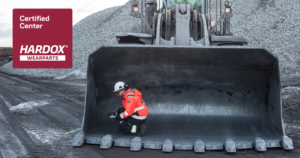
General Machine is a Hardox® Wearparts certified fabricator serving the construction, mining, waste processing, and material handling industries. We fabricate wear parts, liners, buckets, and custom components to spec — and we’re happy to help you figure out what the right spec actually is.